Kubernetes-as-a-Service (KaaS)
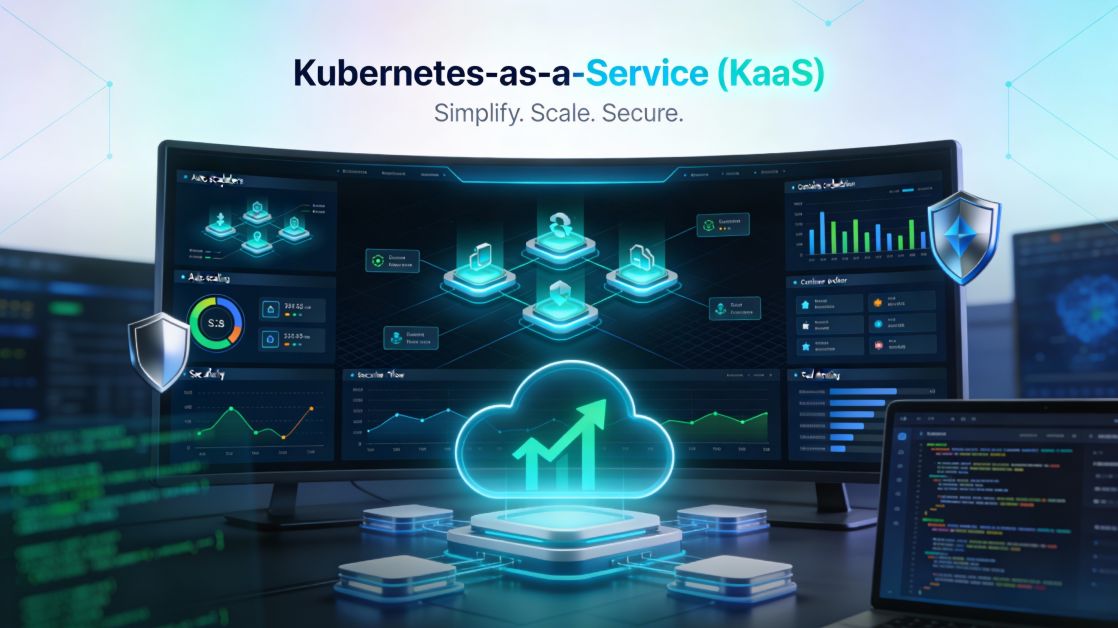
Modern digital products demand speed, stability, and scalability. Therefore, Kubernetes-as-a-Service (KaaS) provides a managed Kubernetes environment that removes infrastructure complexity while enabling high-performance application delivery. As a result, organizations gain full container orchestration benefits without the operational burden of managing clusters.
Meanwhile, engineering teams focus on building applications. At the same time, platform experts handle Kubernetes operations, security, upgrades, and scaling. Consequently, this service model delivers reliability, cost control, and operational clarity for startups, SMBs, and growing enterprises
What Is Kubernetes-as-a-Service (KaaS)
Kubernetes-as-a-Service (KaaS) offers a fully managed Kubernetes platform hosted on cloud infrastructure. Service providers design, deploy, maintain, and monitor Kubernetes clusters while customers run containerized workloads.
The service abstracts control plane management, node configuration, networking, and storage orchestration. Teams access Kubernetes through a simplified interface while retaining flexibility and portability.
KaaS supports modern application architectures including microservices, APIs, event-driven workloads, and CI/CD pipelines.
Why Businesses Choose Kubernetes-as-a-Service
Organizations adopt KaaS to eliminate operational overhead and reduce time to market. As a result, managed Kubernetes environments offer production-grade reliability without the need for in-house Kubernetes expertise.
Meanwhile, development teams gain a stable platform for continuous delivery. In parallel, operations teams achieve predictable performance and governance. Consequently, leadership benefits from controlled costs and reduced risk.
Ultimately, KaaS enables growth without infrastructure bottlenecks.
Core Benefits of Kubernetes-as-a-Service
Reduced Operational Complexity
KaaS providers manage cluster setup, node provisioning, networking, and upgrades. Engineering teams avoid low-level configuration tasks and focus on product delivery.
Automated maintenance ensures cluster health without service disruption.
Faster Application Deployment
Pre-configured Kubernetes environments accelerate deployment pipelines. Developers push code faster while maintaining consistency across environments.
Built-in CI/CD integrations support agile workflows and rapid iteration.
High Availability and Reliability
Managed Kubernetes clusters run across multiple nodes and zones. Automated failover mechanisms protect workloads from outages.
Continuous monitoring identifies issues before they impact users.
Scalable Infrastructure
KaaS supports horizontal and vertical scaling based on workload demand. Auto-scaling adjusts resources in real time to match traffic patterns.
Applications perform consistently during traffic spikes.
Enhanced Security Posture
Security controls apply at cluster, network, and workload levels. Providers implement role-based access, encryption, and vulnerability management.
Regular security updates protect against emerging threats.
Key Features of a Managed KaaS Platform
Cluster Provisioning and Management
KaaS platforms deliver ready-to-use Kubernetes clusters optimized for performance and security. Providers manage control planes, worker nodes, and networking layers.
Users interact through dashboards or APIs.
Automated Scaling
Auto-scaling policies adjust compute resources based on CPU, memory, or custom metrics. Workloads receive adequate capacity during peak usage.
Costs remain controlled during low-traffic periods.
Monitoring and Observability
Built-in monitoring tracks application health, resource usage, and performance metrics. Centralized logging simplifies troubleshooting.
Alerts notify teams of anomalies in real time.
Security and Compliance Controls
Managed Kubernetes environments support compliance requirements such as ISO, SOC, and GDPR readiness. Providers apply security best practices across the stack.
Audit logs track activity and configuration changes.
Backup and Disaster Recovery
Automated backups protect cluster state and persistent data. Disaster recovery strategies enable rapid restoration during failures.
Business continuity remains intact.
Kubernetes-as-a-Service for Startups
Startups require agility and cost efficiency. KaaS delivers enterprise-grade infrastructure without upfront investment.
Teams launch products faster while avoiding infrastructure maintenance. Scaling remains seamless as user adoption grows.
KaaS supports experimentation and innovation without technical debt.
Kubernetes-as-a-Service for SMBs
Small and medium businesses benefit from predictable operations and simplified management. KaaS eliminates the need for dedicated Kubernetes administrators.
Applications gain stability, performance, and security suitable for customer-facing platforms.
SMBs compete effectively with larger enterprises.
Kubernetes-as-a-Service for Enterprises
Enterprises adopt KaaS to standardize container orchestration across teams and regions. Managed platforms support multi-cluster strategies and hybrid cloud models.
Governance policies ensure consistency and compliance at scale.
Enterprise workloads run reliably across environments.
Use Cases for Kubernetes-as-a-Service
Microservices Architecture
KaaS supports loosely coupled microservices with independent scaling and deployment. Teams manage complex service interactions efficiently.
Service discovery and load balancing work seamlessly.
SaaS Application Hosting
SaaS platforms benefit from auto-scaling, high availability, and multi-tenant isolation. KaaS ensures consistent performance for end users.
Operational overhead remains minimal.
CI/CD Pipelines
Continuous integration and deployment pipelines integrate naturally with Kubernetes. Automated testing and rollout strategies reduce deployment risks.
Release cycles accelerate.
API and Backend Services
KaaS provides a resilient environment for APIs and backend systems. Traffic management and rate limiting protect services under load.
Performance remains stable.
Security Architecture in Kubernetes-as-a-Service
Security forms a foundational layer in managed Kubernetes platforms. Providers implement network segmentation, secure ingress controls, and workload isolation.
Image scanning identifies vulnerabilities before deployment. Secrets management protects sensitive credentials.
Access controls enforce least-privilege policies.
Cost Optimization with Kubernetes-as-a-Service
KaaS reduces infrastructure waste through efficient resource allocation. Auto-scaling prevents over-provisioning while maintaining performance.
Usage-based pricing aligns costs with actual demand.
Financial visibility improves planning and forecasting.
KaaS vs Self-Managed Kubernetes
Self-managed Kubernetes requires skilled personnel, ongoing maintenance, and constant monitoring. KaaS shifts these responsibilities to experts.
Managed platforms deliver faster results with lower operational risk.
Organizations gain flexibility without complexity.
Cloud Portability and Vendor Neutrality
Kubernetes-as-a-Service supports cloud-agnostic deployments. Applications remain portable across cloud providers and on-premise environments.
This approach avoids vendor lock-in.
Long-term scalability remains assured.
Performance Optimization in Managed Kubernetes
Providers tune clusters for optimal resource utilization. Load balancing, caching, and network optimization enhance application responsiveness.
Performance benchmarks guide infrastructure decisions.
Users experience consistent service quality.
DevOps Enablement Through KaaS
KaaS strengthens DevOps practices by providing a stable platform for automation. Teams collaborate effectively across development and operations.
Standardized environments reduce friction.
Delivery pipelines mature rapidly.
Observability and Analytics
Advanced analytics provide insights into workload behavior and user demand. Metrics support proactive optimization and capacity planning.
Data-driven decisions improve system reliability.
Visibility extends across the entire stack.
Disaster Recovery and Business Continuity
Managed Kubernetes platforms include redundancy and recovery planning. Applications recover quickly from infrastructure failures.
Downtime remains minimal.
Customer trust stays intact.
Compliance-Ready Kubernetes Environments
KaaS supports regulated industries by enforcing security baselines and auditability. Providers maintain compliance documentation and best practices.
Risk exposure decreases significantly.
Governance remains consistent.
Why Choose Our Kubernetes-as-a-Service
Our Kubernetes-as-a-Service platform delivers reliability, security, and scalability designed for real-world production workloads. Moreover, certified Kubernetes experts manage every layer of the stack.
In addition, customers receive proactive monitoring, transparent pricing, and dedicated support.
As a result, growth becomes predictable and controlled.
Getting Started with Kubernetes-as-a-Service
Onboarding begins with workload assessment and architecture planning. Our team designs a Kubernetes environment aligned with business goals.
Deployment follows proven best practices.
Applications go live faster.
Future-Ready Container Infrastructure
Kubernetes-as-a-Service prepares organizations for evolving technology landscapes. Cloud-native architectures support innovation and rapid change.
Platforms adapt as workloads grow.
Long-term success becomes achievable.
Modern digital businesses increasingly rely on Kubernetes-as-a-Service (KaaS) to simplify container orchestration and infrastructure management. First, KaaS enables rapid application deployment by offering ready-to-use Kubernetes environments. As a result, development teams accelerate release cycles without spending time on cluster configuration. In addition, startups adopt KaaS to reduce operational overhead while maintaining production-grade reliability.
Meanwhile, software-as-a-service providers use KaaS to manage microservices architectures effectively. At the same time, built-in auto-scaling adjusts resources based on real-time demand. Consequently, applications maintain performance during traffic spikes. Furthermore, KaaS supports continuous integration and continuous deployment pipelines. Therefore, updates roll out smoothly with minimal downtime.
Similarly, enterprises implement KaaS for hybrid and multi-cloud strategies. In this scenario, containerized workloads remain portable across cloud providers and on-premise environments. Moreover, centralized monitoring and logging deliver deeper insights into system health. As a result, operations teams detect and resolve issues faster.
Additionally, KaaS plays a critical role in API and backend service hosting. In this context, traffic management and load balancing distribute requests efficiently. Thus, backend services remain responsive under heavy usage. Likewise, data-driven platforms rely on KaaS to process workloads reliably. Consequently, performance consistency improves across applications.
At the same time, security-focused organizations leverage KaaS for role-based access control, network isolation, and automated patching. Because of this, security risks reduce significantly. Furthermore, compliance-driven industries benefit from built-in audit logs and standardized configurations. As a result, regulatory requirements become easier to manage.
In addition, KaaS supports disaster recovery and business continuity strategies. In such cases, automated backups and high-availability configurations protect critical workloads. Therefore, downtime remains minimal during infrastructure failures. Meanwhile, leadership teams gain cost visibility through usage-based pricing models. Consequently, budgeting and forecasting become more predictable.
Ultimately, Kubernetes-as-a-Service enables organizations to scale efficiently, innovate faster, and operate with greater confidence. In conclusion, KaaS serves as a foundational platform for modern cloud-native applications across startups, SMBs, and enterprises.